What is Generative AI? Exploring Its Power, Applications, and Creative Potential

What is Generative AI? Exploring Its Power, Applications, and Creative Potential
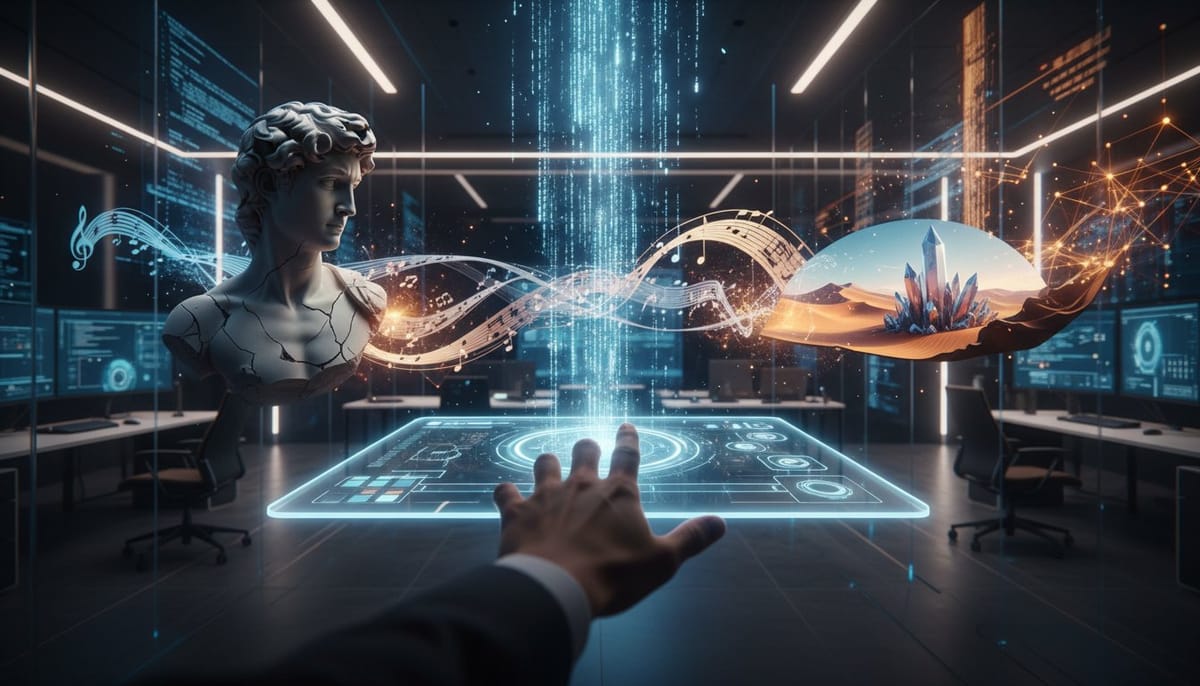
Generative AI is rapidly transforming how we interact with technology and create. This profound shift in artificial intelligence enables machines to create entirely new, original outputs, not just analyze data. Harnessing complex algorithms, it generates novel text, images, audio, video, and code, pushing the boundaries of human creativity. Understanding Generative AI is crucial for navigating the future of technology, content, and innovation, and for developing an effective AI Strategy. For a broader understanding of the field, consult our ultimate guide on AI.
How Generative AI Works
At its core, Generative AI learns patterns from vast datasets to produce new data resembling the training set. This fundamental process is a key aspect of Machine Learning. Unlike discriminative AI, which classifies or predicts, generative models create. For example, teach an AI thousands of cat images: a discriminative AI identifies cats, while a generative AI creates a brand-new, photorealistic cat image.
This is often achieved via sophisticated neural networks:
- Generative Adversarial Networks (GANs): Two competing networks—a generator creating data, and a discriminator distinguishing real from fake—improve each other, leading to convincing outputs.
- Transformers and Diffusion Models: Models like OpenAI's GPT for text or DALL-E for images use these architectures. They excel at context understanding, generating coherent and relevant outputs across modalities by iteratively refining random data based on a prompt. For a deeper dive into the leading research in this space, explore Leading the Charge: A Deep Dive into OpenAI, Anthropic, and the Frontier of AI Research.
The powerful hardware enabling such sophisticated models is critical. Learn more about Nvidia's AI Dominance: The Hardware Powering the Next Generation of Artificial Intelligence.
Key Applications of Generative AI
Generative AI's practical applications span nearly every industry.
Content Creation and Media:
- Text Generation: From marketing copy to code or articles, AI tools produce human-like text at scale, accelerating content production and aiding writers, showcasing the power of advanced NLP Solutions.
- Image and Video Generation: Artists, designers, and marketers create visuals, concept art, and realistic images from text prompts. AI also generates video clips and animations, offering immense potential alongside ethical challenges.
- Music Composition: AI can compose original music in various styles or assist musicians with melodies and harmonies.
Design and Prototyping:
- Product Design: Engineers use AI to explore thousands of design variations, optimizing for factors like strength and weight, significantly accelerating prototyping.
- Architecture: AI generates optimal building layouts and urban designs based on constraints, leading to efficient, sustainable solutions.
Data Augmentation and Synthesis:
- Training AI Models: For scarce or sensitive data, generative AI creates synthetic datasets mimicking real data, invaluable for training other AI models while preserving privacy.
- Scientific Research: Researchers use generative models to synthesize new molecules and simulate processes, accelerating drug discovery, a critical area within Healthcare and life sciences.
Personalization:
- Tailored Experiences: Generative AI crafts highly personalized content, ads, and product recommendations, significantly enhancing user engagement. This focus on personalized AI experiences extends to platforms like those discussed in Grok AI and X: Elon Musk's Vision for an AI-Powered Social Platform.
The Creative Potential of Generative AI
Generative AI unlocks unprecedented creative potential. It democratizes creation, enabling individuals without specialized skills to realize visions via simple prompts. For professionals, it's a powerful co-pilot, augmenting human ingenuity. Artists rapidly iterate, musicians explore new sounds, and writers overcome blocks. This fusion of human intuition and AI power leads to novel artistic expression and problem-solving.
Challenges and Considerations
Despite immense benefits, Generative AI presents significant challenges.
- Ethical Concerns: Hyper-realistic deepfakes raise issues of misinformation and identity theft. Responsible use and robust detection are crucial for robust AI Security. For a comprehensive look at the specific challenges, see The Rise of Deepfakes: Understanding the Technology, Risks, and Detection Methods.
- Bias in Data: Models perpetuate biases present in their training data. Addressing this is a critical research area.
- Intellectual Property: Questions arise regarding ownership of AI-generated content and potential copyright infringement.
- Job Adaptation: While AI creates new roles, it will automate certain tasks, requiring workforce upskilling.
The Future of Generative AI
This field is nascent, with rapid advancements. Expect more sophisticated models understanding complex intent, generating seamless multi-modal outputs, and deeper integration into daily tools. As these technologies mature, they'll redefine industries and reshape our relationship with creativity and information. Ethical frameworks, governance, and public education are vital to harnessing its power for good.
Conclusion
Generative AI represents a monumental leap in AI, empowering machines to create, innovate, and assist in unimaginable ways. From content creation to scientific discovery, its impact is profound. While challenges demand careful navigation, Generative AI's immense potential to augment human capabilities and unlock new creative frontiers promises a future brimming with innovation. Embracing and understanding this technology is key to thriving in the evolving digital landscape, particularly as AI continues to transform sectors like manufacturing and robotics. Explore the impact further with AI in Robotics: How Artificial Intelligence is Transforming Automation and Human-Robot Interaction.