Understanding AI Chips: The Hardware Powering Enterprise AI Solutions

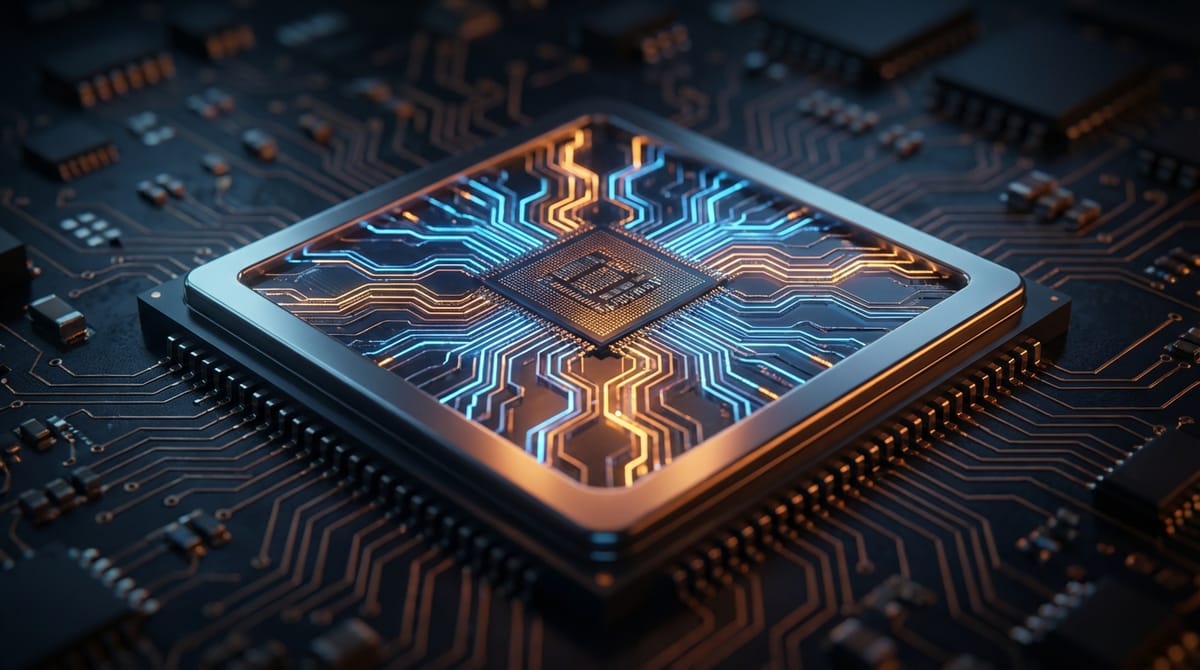
The Engine of Intelligence: Deconstructing AI Chips
In the world of enterprise artificial intelligence, algorithms and data often take center stage. However, the silent, powerful engine driving these innovations is the hardware—specifically, the specialized processors known as AI chips. Unlike the general-purpose CPUs that power our laptops and servers for a wide range of tasks, AI chips are meticulously engineered for one primary purpose: to handle the unique mathematical demands of Machine Learning workloads. This shift from generalist to specialist hardware is the key to unlocking the true potential of modern AI solutions, a topic we cover extensively in our ultimate guide on Enterprise AI.
At their core, AI models, particularly deep learning networks, perform a staggering number of simple mathematical operations, primarily matrix multiplications and tensor operations. A traditional CPU, designed for sequential, complex tasks, would be a bottleneck. AI chips, however, are built for massive parallelism. Imagine asking one master chef (a CPU) to cook a thousand individual burgers versus hiring a thousand line cooks (an AI chip) to each cook one burger simultaneously. The latter approach is vastly more efficient for that specific, repetitive task, and this is the principle that gives AI chips their power.
A Closer Look at the Titans: Key Types of AI Chips
The term "AI chip" isn't a monolith; it encompasses several distinct types of hardware, each with its own strengths, weaknesses, and ideal use cases within an enterprise setting. Understanding these differences is crucial for building an effective AI infrastructure.
GPUs (Graphics Processing Units)
Originally designed to render graphics for video games, GPUs have become the workhorses of AI training. Their architecture consists of thousands of smaller, efficient cores designed to perform parallel computations simultaneously. This makes them exceptionally well-suited for the massive matrix operations required to train deep learning models on vast datasets. Companies like NVIDIA pioneered this space, and their GPUs are now synonymous with large-scale AI development in data centers and cloud environments. They offer a powerful, flexible platform for researchers and developers to build and refine complex AI models.
ASICs (Application-Specific Integrated Circuits)
If a GPU is a versatile army, an ASIC is a highly trained special agent built for a single mission. As the name implies, these chips are custom-designed from the ground up to execute one specific algorithm or set of tasks with maximum efficiency. Google's Tensor Processing Unit (TPU) is a prime example, built specifically to accelerate TensorFlow workloads. For enterprises deploying a specific AI model at a massive scale—a choice that often follows a careful analysis of OpenAI vs. The Competition: Choosing the Right AI Model for Your Business—ASICs offer unparalleled performance-per-watt. Their downside is a complete lack of flexibility; an ASIC designed for image recognition cannot be repurposed for natural language processing. This is a critical consideration for businesses Integrating ChatGPT in the Enterprise: Use Cases, Security, and ROI, as such models require flexible hardware. They shine in high-volume, stable AI applications.
FPGAs (Field-Programmable Gate Arrays)
FPGAs represent a compelling middle ground between the flexibility of GPUs and the efficiency of ASICs. These are integrated circuits that can be reconfigured by a developer after manufacturing. This programmability allows enterprises to create hardware that is highly optimized for their specific AI models, but with the ability to adapt as those models evolve. FPGAs are particularly valuable in low-latency applications like financial trading algorithms or in edge computing scenarios where new AI capabilities might need to be deployed remotely. They offer a unique blend of custom performance and future-proofing.
Hardware in Action: Training vs. Inference
The choice of AI chip is heavily influenced by the specific stage of the AI lifecycle: training or inference.
- AI Training: This is the computationally intensive process of teaching a model by feeding it massive amounts of data. It requires the raw parallel processing power to handle billions of calculations. This is where GPUs are the undisputed champions, often clustered together in powerful servers.
- AI Inference: This is the phase where the trained model is put to work, making predictions on new, live data. The priority here shifts from raw power to efficiency, low latency, and low power consumption. This is the domain where ASICs and FPGAs often outperform. An ASIC in a smart camera, for example, can perform object detection in real-time using minimal power.
Powering Enterprise AI Solutions
The impact of specialized AI chips is felt across every industry. In cloud computing, providers like AWS, Azure, and Google Cloud offer access to vast farms of GPUs and their own custom ASICs, democratizing AI development. In manufacturing, AI chips on the edge power computer vision systems for real-time quality control on assembly lines. The automotive sector relies on them for the complex sensor fusion and decision-making required for autonomous driving, with many of the Top AI Startups Disrupting Industries for Enterprise Adoption focusing on this space. For financial services, they accelerate fraud detection models, analyzing millions of transactions in seconds.
Ultimately, understanding the hardware is no longer just an IT concern; it's a strategic business decision requiring a robust AI Strategy. The right AI chip infrastructure can significantly impact the performance, cost, and scalability of an enterprise's AI initiatives, a fact reflected in The AI Funding Landscape: Key VC Trends for Enterprise Leaders. These initiatives increasingly include applications that show How AI Assistants are Revolutionizing Enterprise Productivity and Workflow. As models become more complex and data volumes grow, these silicon brains will only become more critical, forming the true foundation of the intelligent enterprise.