The Ultimate Guide to Artificial Intelligence: Understanding AI, Its Impact, and Future

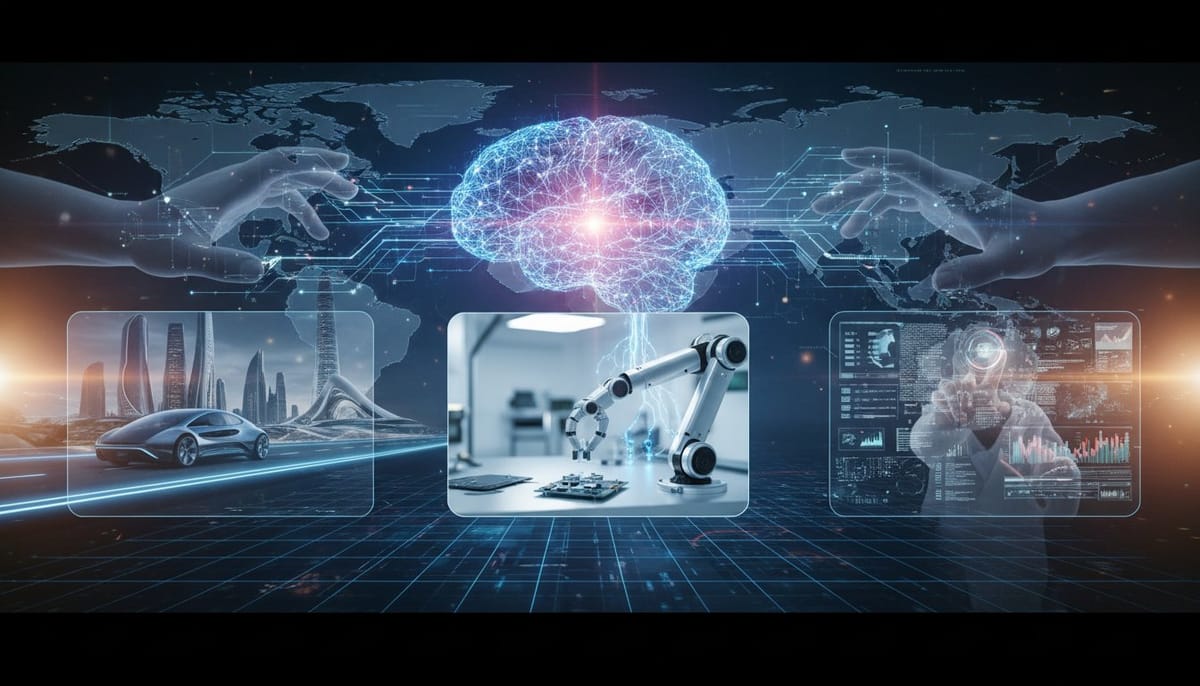
Unveiling the Power of AI: Your Ultimate Guide
Artificial Intelligence, or AI, is no longer a concept confined to the pages of science fiction. It's a transformative force reshaping industries, revolutionizing daily life, and driving humanity into an era of unprecedented innovation. From powering the recommendations on your favorite streaming service to diagnosing diseases and optimizing supply chains, AI's presence is pervasive and growing. But what exactly is AI? How does it work? What are its profound impacts on our world, and what the future holds for this groundbreaking technology? This ultimate guide aims to demystify AI, providing a comprehensive understanding of its intricacies, implications, and immense potential.
At its core, AI refers to the simulation of human intelligence in machines that are programmed to think like humans and mimic their actions. It encompasses a vast array of technologies and disciplines, all working towards enabling machines to learn, reason, perceive, understand language, and even create. The journey into AI is a journey into understanding the very fabric of our evolving technological landscape.
A Brief History of Artificial Intelligence
The seeds of AI were planted long before computers became a household item. The concept of intelligent machines dates back to ancient myths and automatons. However, the formal discipline of AI truly began in the mid-20th century. Pioneers like Alan Turing laid theoretical groundwork with his famous Turing Test in 1950, questioning whether machines could exhibit intelligent behavior indistinguishable from a human.
The term "Artificial Intelligence" itself was coined in 1956 at the Dartmouth Conference, often considered the birth of AI as a field. Early AI research focused on symbolic reasoning and problem-solving, leading to expert systems that could make decisions based on predefined rules. However, these early systems faced limitations, struggling with the complexities and ambiguities of the real world. This led to an "AI winter" in the 1980s, a period of reduced funding and interest.
The resurgence of AI began in the 1990s and accelerated into the 21st century, primarily driven by three key factors: the explosion of data (big data), significant advancements in computational power (especially GPUs), and the development of more sophisticated algorithms, particularly in machine learning and deep learning. Today, AI is experiencing an unprecedented boom, with breakthroughs occurring at an astonishing pace, leading to practical applications across almost every sector imaginable.
Key Concepts and Types of AI
Understanding AI requires delving into its core methodologies and categorizations. The field is vast, but certain concepts form its bedrock.
Machine Learning (ML)
Machine Learning is arguably the most prevalent subset of AI today. Instead of being explicitly programmed for every task, ML algorithms allow systems to learn from data, identify patterns, and make predictions or decisions with minimal human intervention. ML is categorized into several types:
- Supervised Learning: This involves training a model on a labeled dataset, meaning the input data is paired with the correct output. The model learns to map inputs to outputs, and once trained, it can predict outcomes for new, unseen data. Examples include image classification (identifying objects in pictures) and spam detection.
- Unsupervised Learning: Here, the model works with unlabeled data, tasked with finding hidden patterns or structures within the data itself. It's used for clustering similar data points (e.g., customer segmentation) or reducing the dimensionality of data.
- Reinforcement Learning: Inspired by behavioral psychology, this approach trains an agent to make a sequence of decisions in an environment to maximize a cumulative reward. The agent learns through trial and error, receiving rewards for good actions and penalties for bad ones. This is the basis for AI in gaming and autonomous navigation.
Deep Learning (DL)
A specialized subset of Machine Learning, Deep Learning uses neural networks with multiple layers (hence "deep") to learn from vast amounts of data. These neural networks are inspired by the structure and function of the human brain. Deep learning has been instrumental in breakthrough achievements in areas like image recognition, natural language processing, and speech recognition, often achieving superhuman performance.
Natural Language Processing (NLP)
NLP is the branch of AI that enables computers to understand, interpret, and generate human language. This includes tasks like sentiment analysis, language translation, chatbots, virtual assistants (like Siri and Alexa), and text summarization. NLP bridges the gap between human communication and machine understanding.
Computer Vision (CV)
Computer Vision gives machines the ability to "see" and interpret the visual world. It involves tasks such as image recognition, object detection, facial recognition, and scene understanding. Applications range from self-driving cars that recognize pedestrians and traffic signs to medical imaging analysis for disease detection.
Robotics
While AI focuses on the intelligence, robotics deals with the physical machines designed to perform tasks automatically. AI often serves as the