The Role of Nvidia: How GPUs are Powering the AI Revolution

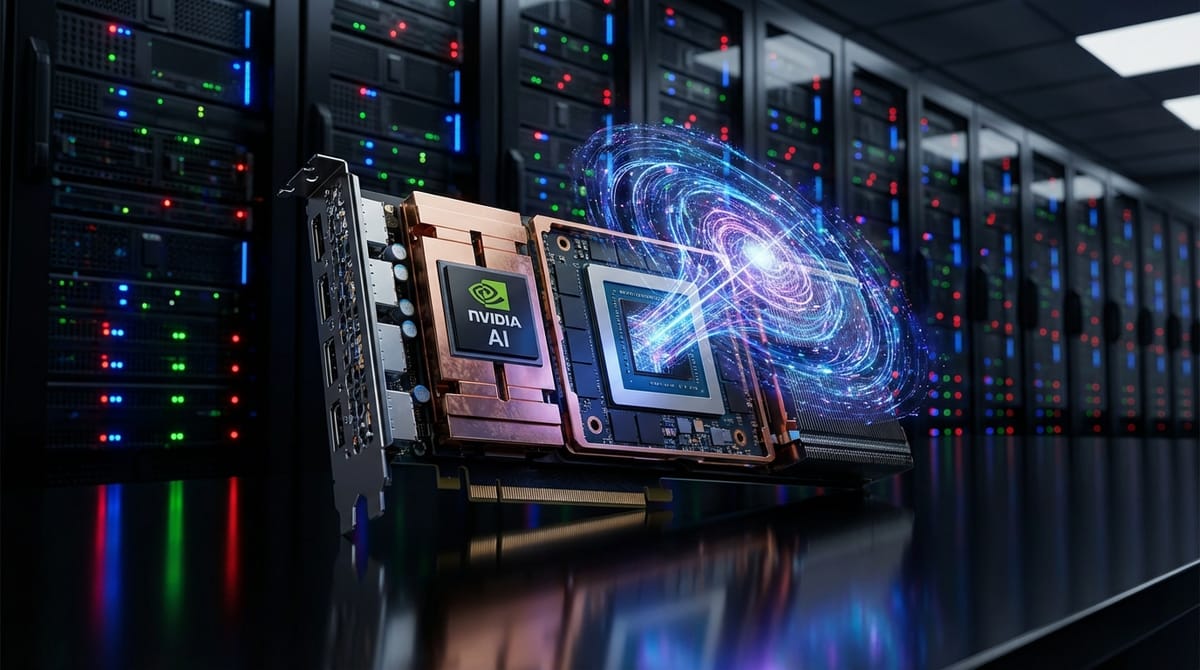
From Pixels to Predictions: The Unlikely Rise of Nvidia AI
In the world of technology, few transformations have been as swift and profound as the rise of artificial intelligence. At the heart of this revolution, which you can read about in our ultimate guide on AI, lies an unlikely hero: the Graphics Processing Unit (GPU). Originally designed to render realistic video game graphics, the GPU’s unique architecture has made it the indispensable engine of modern AI. And at the forefront of this hardware-driven paradigm shift is Nvidia, a company whose name has become synonymous with AI acceleration. The story of Nvidia AI is not just about powerful chips; it’s about a visionary bet on a new kind of computing.
CPUs (Central Processing Units) are the workhorses of traditional computing, designed to execute a sequence of tasks (serial processing) very quickly. GPUs, however, are built for parallel processing. To render a complex 3D scene, a GPU must perform the same simple calculation on millions of pixels simultaneously. Researchers in the early 2000s realized that the mathematical operations used in deep learning—primarily matrix multiplications—were remarkably similar to those used in graphics. This realization marked the beginning of the GPU's journey from gaming rigs to the core of the world's most advanced supercomputers.
The Nvidia AI Ecosystem: More Than Just Silicon
While Nvidia's hardware is undeniably powerful, its true dominance in the AI space comes from a meticulously built ecosystem of software and specialized architecture. This strategic foresight has created a deep competitive moat, making Nvidia the default choice for AI developers and researchers worldwide.
CUDA: The Software That Unlocked the GPU
The single most important catalyst for the Nvidia AI boom is CUDA (Compute Unified Device Architecture). Introduced in 2007, CUDA is a parallel computing platform and programming model that allows developers to use a C-like language to harness the immense parallel processing power of Nvidia GPUs for general-purpose tasks. Before CUDA, programming a GPU for non-graphical work was an arcane, complex process. CUDA democratized GPU computing, opening the floodgates for a wave of innovation. It provided the essential bridge that allowed the abstract mathematical concepts of neural networks to be translated into concrete, lightning-fast computations on hardware.
Specialized Libraries and Tensor Cores
Building on the foundation of CUDA, Nvidia developed a suite of specialized libraries that further abstract away complexity. The CUDA Deep Neural Network library (cuDNN), for instance, provides highly tuned routines for standard deep learning operations like convolutions and pooling. This allows developers to build AI models faster without having to optimize the low-level code themselves. Furthermore, Nvidia introduced a hardware innovation called Tensor Cores, starting with its Volta architecture. These are specialized processing units within the GPU designed specifically to accelerate the matrix multiplication and accumulation operations that are the computational backbone of training and running AI models. Each subsequent generation—from Turing to Ampere to the latest Hopper architecture (powering the H100 and H200 GPUs)—has dramatically increased the performance and efficiency of these Tensor Cores.
Real-World Impact: Where Nvidia GPUs Power Progress
The practical applications of the Nvidia AI platform are transforming entire industries, a clear example of How Enterprise AI is Revolutionizing Business Operations. Its impact is not theoretical; it's happening right now, powering services and discoveries that affect millions of lives.
Generative AI and Large Language Models (LLMs)
The recent explosion in generative AI, exemplified by models like ChatGPT, DALL-E, and Midjourney, is directly enabled by massive clusters of Nvidia GPUs. Training these colossal models, which can have trillions of parameters, requires an astronomical amount of computation. It involves feeding the model vast datasets for weeks or even months. This is only feasible on large-scale systems like Nvidia's DGX SuperPOD, which links thousands of their most powerful GPUs together with high-speed interconnects to work as a single, massive AI supercomputer. The race to build these systems has intensified the competition between AI Giants: Comparing the Strategies and Innovations of OpenAI and Meta.
Scientific Research and Healthcare
Beyond language and images, Nvidia AI is accelerating scientific discovery. In drug discovery, GPUs are used to simulate molecular interactions, drastically reducing the time it takes to identify promising new drug candidates. In genomics, they power the analysis of complex DNA sequences. Projects like AlphaFold, which revolutionized protein folding prediction, were trained and run on GPU-powered systems. This computational power allows scientists to tackle problems that were once considered unsolvable.
Autonomous Systems and Robotics
The future of transportation and automation relies on real-time AI. Autonomous vehicles must process a torrent of data from cameras, LiDAR, and radar to perceive the world and make split-second decisions. Nvidia's DRIVE platform provides the high-performance, energy-efficient compute necessary for in-vehicle AI. Similarly, in robotics, GPUs process visual data for navigation, object recognition, and manipulation, making factories smarter and logistics more efficient. These powerful machines are an early look into the concepts behind What are AI Agents? The Next Frontier in Autonomous Systems.
The Unstoppable Momentum of AI Compute
Nvidia's journey from a graphics card company to the undisputed leader in AI infrastructure is a testament to its long-term vision and effective AI strategy. By building a comprehensive ecosystem of hardware, software, and libraries, it has not only powered the current AI revolution but has also positioned itself as the foundational platform for whatever comes next. As AI models continue to grow in complexity and scale, the demand for specialized, parallel computing will only intensify. Nvidia isn't just selling chips; it's selling the picks and shovels in a new technological gold rush, shaping The Landscape of AI Startups: Securing VC Funding in a Competitive Market, and for the foreseeable future, its role as the engine of AI seems secure.