Nvidia's AI Dominance: The Hardware Powering the Next Generation of Artificial Intelligence

The Unseen Architect: How Nvidia Fuels the AI Revolution
In the rapidly accelerating world of Artificial Intelligence, one company's name consistently emerges as the fundamental enabler: Nvidia. Far beyond its origins in graphics processing, Nvidia has strategically positioned itself as the indispensable hardware provider, powering everything from groundbreaking large language models (LLMs) to the complex simulations driving scientific discovery and autonomous vehicles. This isn't merely about selling chips; it's about building the foundational infrastructure that allows AI researchers, developers, and enterprises to push the boundaries of what's possible. Understanding Nvidia's dominance means delving into the specific hardware innovations and the comprehensive ecosystem it has meticulously crafted, which collectively make it the backbone of the next generation of artificial intelligence.
Beyond Graphics: The Genesis of GPU Computing for AI
The story of Nvidia's AI dominance begins not with AI itself, but with the inherent capabilities of its Graphics Processing Units (GPUs). Initially designed to render complex 3D graphics by performing vast numbers of parallel computations simultaneously, GPUs proved to be an unexpected boon for scientific computing. Machine learning, particularly deep learning, thrives on parallel processing – performing millions of matrix multiplications and additions concurrently. Unlike traditional CPUs, which excel at sequential tasks, GPUs are architectural marvels of parallel computation, making them perfectly suited for the computational demands of neural networks.
CUDA: Unlocking Parallel Potential
The turning point for Nvidia's foray into general-purpose computing, and subsequently AI, was the introduction of CUDA (Compute Unified Device Architecture) in 2006. CUDA is a parallel computing platform and programming model that allows software developers to use a GPU for general-purpose processing. This visionary move transformed GPUs from specialized graphics accelerators into versatile parallel supercomputers. With CUDA, researchers could program GPUs to tackle complex mathematical problems far beyond rendering pixels, providing the essential toolkit for the burgeoning fields of machine learning and deep learning. It fostered an ecosystem that attracted developers and laid the groundwork for AI breakthroughs that followed.
Nvidia's Specialized AI Hardware: Powering Breakthroughs
As AI evolved, Nvidia didn't rest on its laurels; it began designing hardware specifically optimized for the unique demands of AI workloads, both for training and inference.
Tensor Cores: The AI Accelerators
A monumental innovation arrived with the Volta architecture in 2017: Tensor Cores. These are specialized processing units within Nvidia GPUs designed to dramatically accelerate matrix operations, which are the computational heart of deep learning. Tensor Cores perform mixed-precision calculations, offering a significant boost in training performance and efficiency without compromising accuracy. They are crucial for accelerating tasks like the training of colossal transformer models used in LLMs, effectively delivering orders of magnitude improvement over traditional GPU cores for AI tasks. Each subsequent generation of Nvidia GPUs has enhanced Tensor Cores, making them more powerful and versatile.
From Volta to Blackwell: A Lineage of AI Prowess
Nvidia's commitment to AI is evident in its relentless hardware roadmap. The Volta architecture introduced Tensor Cores. Ampere (e.g., A100 GPU) refined them and brought forth Multi-Instance GPU (MIG) technology, allowing a single GPU to be partitioned for various workloads. The current generation, Hopper (e.g., H100 GPU), further elevates AI performance with advanced Transformer Engine capabilities, fourth-generation Tensor Cores, and groundbreaking interconnectivity. Looking ahead, the recently announced Blackwell architecture promises even more staggering performance gains, larger models, and enhanced energy efficiency, further solidifying Nvidia's position at the forefront of AI hardware innovation. Each generation represents not just an incremental improvement, but a significant leap in computational capability for increasingly complex AI models.
DGX Systems and Data Center Dominance
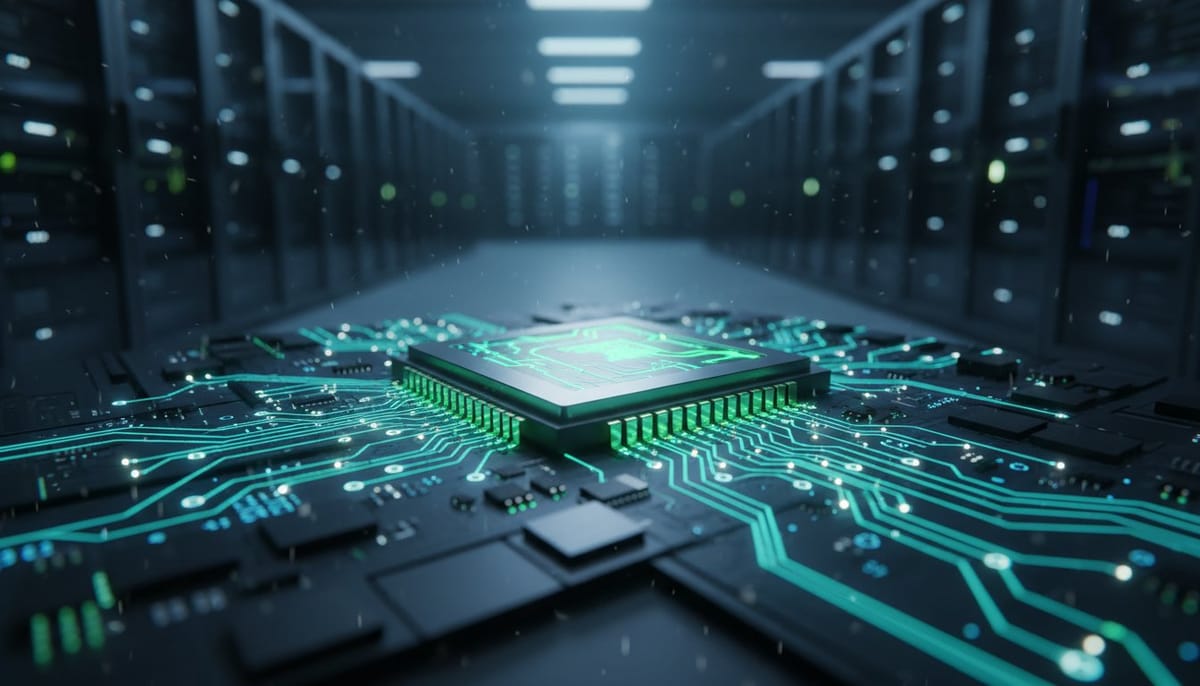
Beyond individual GPUs, Nvidia recognized the need for integrated, scalable AI infrastructure. This led to the creation of Nvidia DGX systems. These are self-contained, purpose-built AI supercomputers, ranging from individual workstations (DGX Station) to racks of interconnected GPUs (DGX SuperPOD). DGX systems integrate Nvidia's most powerful GPUs, high-speed networking (NVLink, InfiniBand), optimized software stacks, and enterprise-grade support, simplifying the deployment and management of complex AI workloads for businesses and research institutions. Nvidia's dominance in the data center is thus not just about providing the best chips, but about offering complete, robust solutions that accelerate the entire AI development and deployment lifecycle, from initial research to large-scale production inference.
The Interconnected Ecosystem: Networking and Software
Great hardware alone isn't enough; it needs high-speed communication and a robust software layer to reach its full potential, especially in distributed AI training environments.
NVLink and InfiniBand: Bridging the Gaps
For AI models to scale across multiple GPUs and even multiple servers, efficient data transfer is paramount. NVLink is Nvidia's proprietary high-speed interconnect technology that allows GPUs to communicate directly with each other at much higher bandwidths than traditional PCIe. This is critical for training massive models that cannot fit on a single GPU. For scaling across an entire data center, Nvidia's acquisition of Mellanox (now Nvidia Networking) brought InfiniBand into its portfolio. InfiniBand is a high-performance, low-latency networking technology essential for linking hundreds or thousands of GPUs in large AI supercomputers, ensuring data can flow freely and rapidly between processing units.
Complementing this hardware is a vast software ecosystem, including the CUDA toolkit, cuDNN (CUDA Deep Neural Network library), TensorRT (an SDK for high-performance deep learning inference), and numerous frameworks optimized for Nvidia GPUs. This comprehensive stack ensures developers have the tools to fully leverage Nvidia's powerful hardware.
Real-World Impact: Where Nvidia's AI Hardware Shines
- Large Language Models (LLMs) and Generative AI: The development and deployment of models like GPT, LLaMA, and Stable Diffusion are heavily reliant on Nvidia's high-performance GPUs and DGX systems for both training and inference.
- Scientific Computing and Drug Discovery: Researchers leverage Nvidia GPUs to simulate complex molecular interactions, accelerate drug discovery, and tackle grand challenges in physics and chemistry.
- Autonomous Vehicles and Robotics: Nvidia's DRIVE platform and Jetson modules provide the computational power for real-time sensor processing, perception, and decision-making in self-driving cars and intelligent robots.
- Hyperscale Cloud AI Infrastructure: Major cloud providers like AWS, Azure, and Google Cloud extensively use Nvidia GPUs to offer scalable AI services to their customers, democratizing access to powerful AI compute.
- Healthcare AI Diagnostics: From medical imaging analysis to personalized medicine, Nvidia's hardware is instrumental in developing AI solutions that improve diagnostic accuracy and patient outcomes.
The Future of AI, Powered by Nvidia
Nvidia's strategic foresight, relentless innovation in hardware design, and comprehensive software ecosystem have cemented its position as the undisputed leader in AI computing. As AI continues to evolve, demanding even greater computational power, efficiency, and scalability, Nvidia remains at the forefront, continually pushing the boundaries of what its hardware can achieve. The company's ongoing investments in research and development, coupled with its robust partner ecosystem, ensure that Nvidia will continue to be the hardware power underpinning the next, more sophisticated generation of artificial intelligence, shaping industries and transforming our world.