Nvidia: Powering the Future of Artificial Intelligence Hardware

The Unmatched Dominance of Nvidia in AI Hardware
In the rapidly evolving landscape of Artificial Intelligence, one company stands out as the undisputed leader in providing the foundational hardware that powers virtually every significant AI breakthrough: Nvidia. When we talk about "Nvidia AI Hardware," we're not just discussing components; we're talking about an entire ecosystem of specialized processors, platforms, and software designed from the ground up to accelerate complex AI workloads, from deep learning training to real-time inference. Understanding Nvidia's role is crucial for anyone looking to grasp the current and future trajectory of AI. For a comprehensive overview, refer to our ultimate guide on AI.
The Genesis: From Gaming GPUs to AI Supercomputing
Nvidia's journey to AI dominance began with its expertise in graphics processing units (GPUs) for gaming. These GPUs, designed to render parallel graphics operations, serendipitously proved to be exceptionally well-suited for the parallel processing demands of Machine Learning and neural networks. The ability to perform thousands of calculations simultaneously, far exceeding the capabilities of traditional CPUs for certain tasks, became the bedrock of modern deep learning.
- CUDA: The Parallel Computing Platform: Central to Nvidia's success is CUDA (Compute Unified Device Architecture). This proprietary parallel computing platform and programming model allows developers to leverage the immense power of Nvidia GPUs for general-purpose computing. CUDA provides the software layer that translates complex AI algorithms into instructions that GPUs can execute with unparalleled efficiency. Without CUDA, the widespread adoption of GPUs for AI would have been significantly delayed.
- Tensor Cores: AI's Dedicated Engine: Recognizing the specific mathematical operations prevalent in AI (especially matrix multiplications), Nvidia introduced Tensor Cores with its Volta architecture. These specialized processing units are purpose-built to accelerate mixed-precision matrix arithmetic, which is fundamental to deep learning training and inference. Tensor Cores dramatically boost the performance of AI models, making state-of-the-art research and applications feasible.
Key Nvidia AI Hardware Platforms and Products
Nvidia's AI hardware extends beyond individual GPUs to include integrated systems and platforms tailored for different scales and applications.
High-Performance Data Center AI: DGX Systems and H100/A100 GPUs
For large-scale AI research and deployment, Nvidia's data center solutions are paramount.
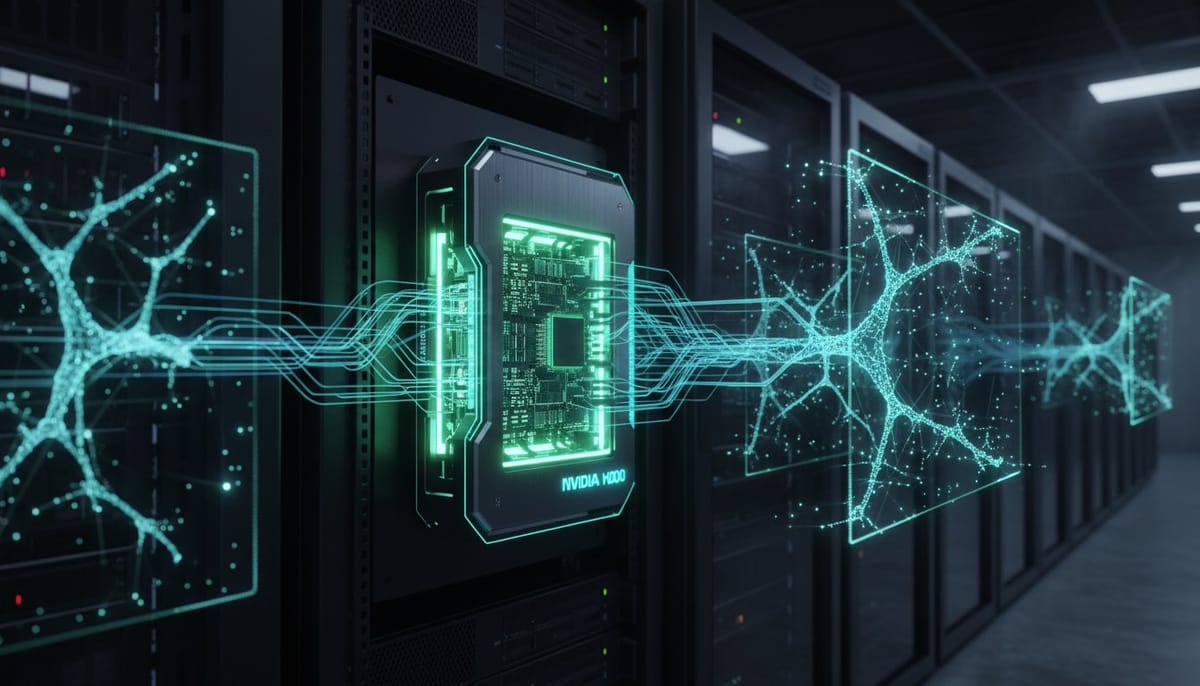
- Nvidia A100 and H100 GPUs: These are the workhorses of modern AI data centers. The A100, based on the Ampere architecture, and its successor, the H100, powered by the Hopper architecture, represent the pinnacle of AI acceleration. They feature thousands of CUDA Cores, hundreds of Tensor Cores, massive memory bandwidth (HBM2e/HBM3), and crucial interconnect technologies like NVLink and NVSwitch, which enable multiple GPUs to communicate at extremely high speeds, effectively creating a single, powerful AI supercomputer. These GPUs are designed for both training massive AI models and accelerating complex inference tasks at scale, including those that power advanced applications like those discussed in The Rise of Deepfakes: Understanding AI-Powered Synthetic Media.
- Nvidia DGX Systems: The DGX line comprises fully integrated, optimized AI supercomputers. A DGX Station or DGX SuperPOD bundles multiple GPUs (like A100s or H100s) with high-speed networking, storage, and a complete software stack (Nvidia AI Enterprise). These systems provide an out-of-the-box solution for enterprises and research institutions to tackle their most demanding AI workloads, eliminating the complexities of building and optimizing custom hardware infrastructure.
Edge AI and Robotics: Nvidia Jetson
AI isn't confined to data centers; it's increasingly moving to the edge – devices like robots, drones, smart cameras, and autonomous vehicles that need to process AI in real-time with low latency and power consumption.
- Nvidia Jetson Platform: The Jetson family of embedded computing boards (e.g., Jetson Nano, Jetson Xavier NX, Jetson AGX Orin) brings Nvidia's GPU-accelerated AI capabilities to the edge. These compact, power-efficient modules integrate a GPU, CPU, memory, and various interfaces, enabling developers to deploy sophisticated AI applications directly on devices. From object detection in manufacturing to autonomous navigation in robotics, Jetson empowers intelligent edge computing, similar to how AI is applied in sectors like How AI is Transforming Logistics: A Deep Dive into DoorDash's AI Applications.
The Indispensable Software Ecosystem
While hardware is critical, Nvidia's comprehensive software stack maximizes the performance and usability of its AI hardware.
- Nvidia AI Enterprise: A complete, cloud-native suite of AI and Data Analytics software that simplifies the development and deployment of AI. It includes popular frameworks, pre-trained models, and optimizers.
- cuDNN: The CUDA Deep Neural Network library, a GPU-accelerated library of primitives for deep neural networks, providing highly tuned implementations of standard routines like convolutions, pooling, and normalization.
- TensorRT: An SDK for high-performance deep learning inference. TensorRT optimizes trained neural networks for deployment, often achieving significant speedups in inference latency and throughput on Nvidia GPUs.
Nvidia's Future in AI Hardware
Nvidia continues to push the boundaries of AI hardware with new architectures and innovations. The demand for more powerful, efficient, and scalable AI infrastructure is insatiable, driven by the increasing complexity of models like large language models (LLMs) and diffusion models. These advancements include exciting new developments like those covered in What is Grok AI? Elon Musk's Vision for Conversational AI. Nvidia's ongoing investment in chip design, interconnect technologies, and its robust software ecosystem ensures its continued leadership in powering the future of artificial intelligence across all scales, from the data center to the device, a dynamic landscape also shaped by Meta's AI Initiatives and the Thriving World of AI Startups.