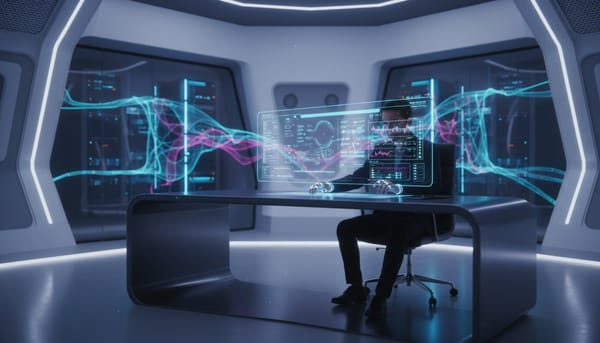
The Hardware of AI: Why Nvidia and Modern Data Centers are Crucial for Success

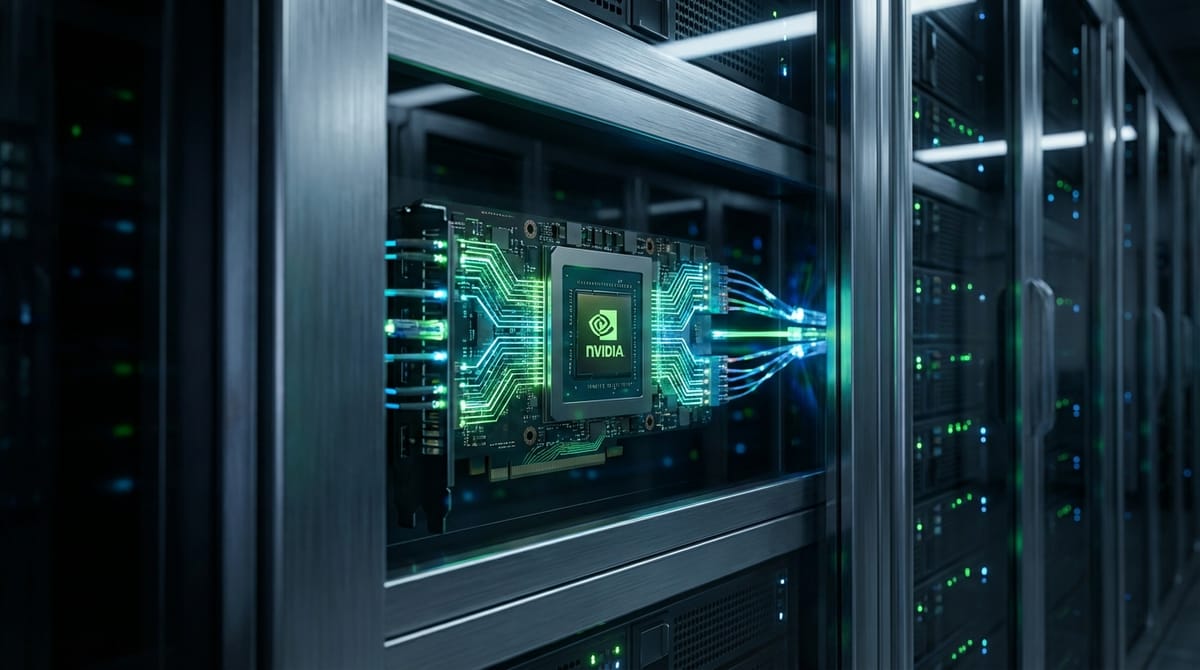
The Unseen Engine: How Nvidia GPUs Power the AI Revolution
When we talk about Artificial Intelligence, our minds often jump to sophisticated algorithms, complex neural networks, and groundbreaking applications like ChatGPT or autonomous driving. We think of the software—the "brain" of the operation. But behind every intelligent response and every learned task lies a powerful, often overlooked physical foundation: the hardware. And in the world of AI hardware, one name stands above all others: Nvidia.
To truly understand the AI landscape, as explored in our ultimate guide on Enterprise AI, we must look inside the modern data center and appreciate the specialized architecture that makes it all possible. It's a story of parallel processing, visionary engineering, and how a company known for gaming graphics became the indispensable engine of the AI revolution.
CPU vs. GPU: The Core of the Matter
For decades, the Central Processing Unit (CPU) was the undisputed king of computing. It's designed to be a jack-of-all-trades, executing a wide variety of tasks sequentially with incredible speed. Think of a CPU as a world-class chef who can expertly prepare any single dish you ask for, one after another.
However, the mathematics behind modern AI, particularly deep learning, doesn't require one master chef. It requires an army of line cooks all performing a similar, relatively simple task simultaneously. This task is usually matrix multiplication—a core operation in training neural networks. Training a large language model involves trillions of these calculations.
This is where the Graphics Processing Unit (GPU) shines. Originally designed to render millions of pixels on a screen at once for video games, GPUs are built for massive parallel processing. Instead of having a few powerful cores like a CPU, a high-end Nvidia GPU has thousands of smaller, more specialized cores. This architecture allows it to handle thousands of calculations concurrently, making it exponentially faster than a CPU for the repetitive, parallelizable workloads that define AI training and inference.
The CUDA Moment: Unlocking the GPU for AI
Nvidia's journey from a gaming hardware company to an AI behemoth wasn't accidental. It was the result of a strategic innovation that transformed the industry: CUDA (Compute Unified Device Architecture). Launched in 2006, CUDA is a parallel computing platform and programming model that allows developers to use Nvidia GPUs for general-purpose processing.
Before CUDA, programming a GPU for anything other than graphics was a highly complex and arcane process. CUDA provided a relatively simple C-like language and a set of tools that opened the floodgates for researchers and scientists. They could now directly harness the immense parallel power of Nvidia's hardware for scientific simulations, data analysis, and, most importantly, machine learning. This strategic software layer created a powerful ecosystem, locking developers into Nvidia's hardware and giving the company a massive head start in the nascent AI field.
Inside the AI Powerhouse: Key Nvidia Technologies
What makes a modern Nvidia GPU, like the A100 or H100, so perfectly suited for AI? It's not just the sheer number of cores. It's a suite of specialized components working in concert.
Tensor Cores
First introduced in their Volta architecture, Tensor Cores are the specialized "line cooks" in our kitchen analogy. They are specifically designed to accelerate one type of operation: matrix multiplication and accumulation, the fundamental building block of deep learning. Each new generation of Nvidia GPUs brings more powerful and versatile Tensor Cores, dramatically speeding up both the training of new AI models and the process of running them (inference).
High-Bandwidth Memory (HBM)
AI models are not only computationally intensive but also incredibly data-hungry. A model like GPT-3 has billions of parameters that need to be accessed constantly during training. Traditional computer memory (DRAM) can become a bottleneck, starving the thousands of GPU cores of the data they need to stay busy. Nvidia GPUs use High-Bandwidth Memory (HBM), which is stacked vertically next to the GPU die, providing a much wider, faster data pipeline. This ensures the cores are constantly fed, maximizing efficiency.
NVLink and NVSwitch
No single GPU, no matter how powerful, can train the largest state-of-the-art models. The solution is to connect multiple GPUs to work together on the same problem. This is where NVLink comes in. It's a high-speed interconnect that allows for direct, ultra-fast communication between GPUs, bypassing the much slower system bus. This technology lets a cluster of eight, sixteen, or even thousands of GPUs act like one massive, cohesive computing unit, essential for the supercomputing scale of modern AI development.
The AI Factory: Nvidia's Role in the Data Center
The modern data center is no longer just a repository for websites and corporate data; it's an "AI factory." Nvidia is at the heart of this transformation, providing not just the individual GPUs but entire integrated systems. The Nvidia DGX line, for example, is a series of pre-built, fully optimized servers—often called "AI supercomputers in a box"—that combine multiple top-tier GPUs with NVLink, networking, and a full stack of optimized AI software. This allows organizations to deploy powerful AI infrastructure without the immense complexity of building it from scratch, though success always hinges on a well-defined AI Strategy.
Ultimately, Nvidia's dominance isn't just about silicon. It's about the complete ecosystem they've built—from the hardware architecture and interconnects to the CUDA platform and a vast library of software (like cuDNN for deep neural networks). This holistic approach has made Nvidia the foundational platform upon which the modern AI world is built, turning data centers into crucibles of innovation. The applications that stem from this power are transformative, from How AI Agents are Revolutionizing Business Automation and Workflow to the enterprise tools that go Beyond the Basics: Implementing AI Assistants to Enhance Enterprise Productivity. As this revolution accelerates, it's also crucial to understand the economic drivers by Decoding VC Funding in the AI Space: Trends and Opportunities for Startups and to prepare for The Impact of AI on the Workforce: Preparing Your Team for the Future.