Generative AI Ecosystem: Key Players and Technologies Explained

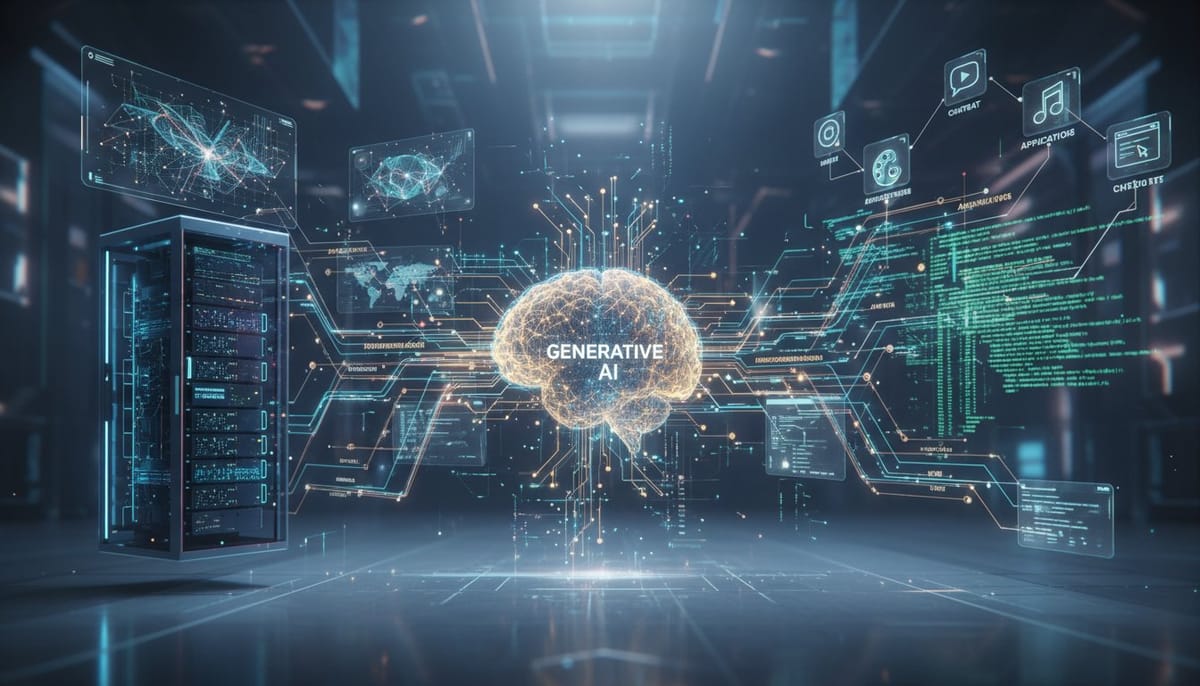
Understanding the Generative AI Ecosystem
The landscape of Generative AI is evolving at an unprecedented pace, transforming industries and opening new frontiers for innovation. To see more examples of AI in Action: Robotics, Funding, and Real-World Applications, explore our blog. Far from being a monolithic entity, Generative AI thrives within a complex, interconnected ecosystem comprising various technologies, platforms, and key players. For businesses and developers looking to harness its power, understanding this ecosystem is not just beneficial—it's essential for strategic decision-making and successful implementation.
What is Generative AI?
Generative AI refers to artificial intelligence systems capable of generating new, original content across various modalities, including text, images, audio, video, and code. Unlike discriminative AI, which classifies or predicts based on existing data, generative models learn patterns and structures from vast datasets to create novel outputs. This includes everything from writing compelling marketing copy and developing realistic images to synthesizing human-like speech and crafting functional code snippets.
Why Explore the Ecosystem?
Navigating the Generative AI ecosystem allows you to identify the right tools and partners for your specific needs. It helps in:
- Strategic Tool Selection: Choosing the most suitable foundation models, frameworks, and infrastructure.
- Optimizing Costs: Understanding licensing, API usage, and deployment costs associated with different providers.
- Maximizing Performance: Leveraging specialized models or fine-tuning techniques for superior results.
- Future-Proofing: Staying abreast of emerging technologies and trends to maintain a competitive edge.
- Risk Mitigation: Being aware of ethical considerations, data privacy, and security implications of various platforms.
Key Pillars of the Generative AI Ecosystem
The Generative AI ecosystem can be broadly categorized into several interconnected pillars, each playing a crucial role in the development and deployment of generative applications.
Foundation Models & Providers
At the core are the foundation models – large-scale AI models trained on vast amounts of data, capable of performing a wide range of tasks. These models are often made available through APIs or as open-source packages.
- Large Language Models (LLMs): Examples include OpenAI's GPT series (GPT-3.5, GPT-4), Google's PaLM and Gemini, Anthropic's Claude, and Meta's Llama series. These excel at text generation, summarization, translation, and more.
- Large Multimodal Models (LMMs): Capable of understanding and generating content across multiple modalities (e.g., text and images), like Google's Gemini or OpenAI's GPT-4V.
- Image/Video Generation Models: Such as Stability AI's Stable Diffusion, Midjourney, and DALL-E.
Practical Tip: When choosing a foundation model, consider its performance benchmarks for your specific task, API accessibility, cost-per-token, available fine-tuning options, and the community support surrounding it. For highly sensitive data or specialized tasks, a smaller, fine-tuned open-source model might be more cost-effective and performant than a large, general-purpose proprietary model.
Development Frameworks & Tools
These are libraries and platforms that simplify the interaction with foundation models and aid in building complex generative AI applications.
- Orchestration Frameworks: LangChain and LlamaIndex are popular for chaining together LLM calls, external data sources, and other tools to create sophisticated applications like chatbots or RAG (Retrieval Augmented Generation) systems.
- Model Hubs & Libraries: Hugging Face's Transformers library and its model hub provide access to thousands of pre-trained models and tools for fine-tuning.
- Machine Learning Frameworks: TensorFlow and PyTorch remain foundational for researchers and developers building custom models or extending existing ones.
Practical Tip: For rapid prototyping and complex chain-of-thought applications, leverage frameworks like LangChain. If you're primarily working with open-source models and need fine-tuning capabilities, Hugging Face is an invaluable resource. Understanding these tools drastically reduces development time.
Data Infrastructure & Management
Effective Generative AI relies heavily on robust data infrastructure, especially for fine-tuning models or implementing RAG.
- Vector Databases: Essential for RAG, these databases store embeddings (numerical representations of data) and enable efficient semantic search. Key players include Pinecone, Weaviate, Milvus, and Qdrant.
- Data Labeling & Annotation Platforms: Services that help prepare high-quality datasets for training and fine-tuning.
- MLOps Platforms: Tools for managing the entire machine learning lifecycle, from data preparation and model training to deployment, monitoring, and governance.
Practical Tip: Implement a strong data governance strategy from the outset. For RAG applications, invest in a suitable vector database and establish clear pipelines for embedding and indexing your proprietary data. High-quality, domain-specific data is often the differentiator for successful Generative AI implementations.
Application Layers & Integrations
This pillar represents the end-user applications and services that integrate Generative AI capabilities.
- AI Assistants: Chatbots, virtual assistants, and conversational AI platforms.
- Content Generation Tools: AI writers, image generators, video editors.
- Code Assistants: Tools like GitHub Copilot that generate code suggestions.
- Design & Creative Tools: AI-powered tools for graphic design, music composition, and more.
Practical Tip: Identify existing workflows or products where Generative AI can add significant value. Start with targeted integrations that solve a specific pain point rather than attempting a complete overhaul. User experience remains paramount; AI should augment, not complicate.
Navigating the Ecosystem: A Practical Approach
Step 1: Define Your Use Case
Clearly articulate the problem you want to solve or the value you want to create. Is it automating customer service, generating marketing copy, personalizing user experiences, or assisting developers? A well-defined use case guides all subsequent decisions.
Step 2: Evaluate Foundation Models
Based on your use case, research and benchmark different foundation models. Consider factors like: accuracy for your domain, cost, latency, token limits, and whether fine-tuning is necessary. Experiment with APIs from various providers to get a feel for their capabilities.
Step 3: Select Your Development Stack
Choose orchestration frameworks (e.g., LangChain), libraries (e.g., Hugging Face), and programming languages that align with your team's expertise and the project's requirements. Consider cloud-based platforms for scalability and ease of deployment.
Step 4: Data Preparation & Integration
Determine your data strategy. Will you use RAG with a vector database to provide models with up-to-date, proprietary information? Or will you fine-tune a model on your specific dataset for specialized tasks? Plan for data ingestion, cleaning, embedding, and indexing.
Step 5: Build, Test, and Iterate
Start with a minimum viable product (MVP). Develop prototypes, rigorously test performance and safety, gather user feedback, and iterate. Implement MLOps practices for continuous monitoring, evaluation, and improvement of your Generative AI applications.
Challenges and Future Outlook
Key Challenges
The Generative AI ecosystem faces challenges including ethical concerns (bias, misinformation), high computational costs, model complexity, regulatory uncertainty, and the need for specialized talent.
Future Trends
Expect continued growth in open-source models, advancements in multimodal AI, increasing specialization of models for niche tasks, and greater emphasis on explainability and responsible AI development. The ecosystem will likely become even more diverse and interconnected.
By systematically exploring and understanding the Generative AI ecosystem, businesses and developers can confidently navigate its complexities, unlock its immense potential, and drive meaningful innovation in the years to come. For an even broader understanding of the field, refer to our ultimate guide on AI.