AI Infrastructure: Key Players, Data Centers, and AI Chips Explained

Decoding AI Infrastructure: A Practical Guide to Key Players, Data Centers, and AI Chips
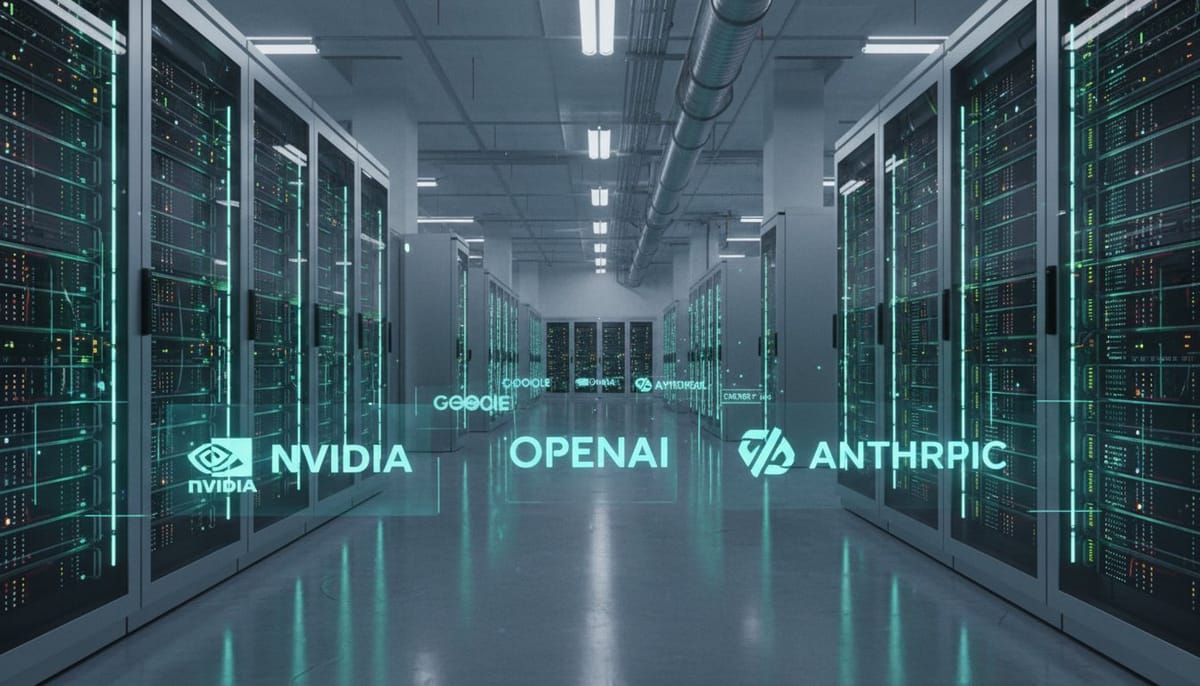
The rapid advancement of artificial intelligence is fundamentally reliant on a robust and specialized infrastructure. Understanding the core components—AI chips, data centers, and the strategies of key players like OpenAI, Anthropic, Google, and Nvidia—is crucial for anyone looking to build, deploy, or simply comprehend the power behind modern AI. This guide offers practical insights into navigating this complex landscape, helping you make informed decisions about leveraging AI infrastructure for your projects. For a deeper dive into the broader AI landscape, consider our ultimate guide on AI.
The Engine of AI: Understanding AI Chips
At the heart of every AI operation lies specialized silicon designed for parallel processing: the AI chip. These aren't just standard CPUs; they are optimized for the massive matrix multiplications and tensor operations that define deep learning.
- Graphical Processing Units (GPUs): Initially designed for rendering graphics, GPUs from companies like Nvidia have become the de facto standard for AI training due to their architecture with thousands of smaller cores. Nvidia's CUDA platform further cemented its dominance, providing a comprehensive software ecosystem that developers rely on.
- Application-Specific Integrated Circuits (ASICs): Custom-designed for specific tasks, ASICs offer superior performance and efficiency for particular AI workloads. Google's Tensor Processing Units (TPUs) are a prime example, built from the ground up to accelerate TensorFlow computations.
- Field-Programmable Gate Arrays (FPGAs): These offer a middle ground, providing flexibility to reconfigure hardware after manufacturing, making them suitable for evolving AI algorithms or niche applications where customizability is key.
Practical Tip: Assessing Your Chip Needs
When approaching an AI project, consider:
- Workload Type: Is it heavy training (requiring massive parallel processing like GPUs/TPUs) or inference (can often run on less powerful, more energy-efficient hardware)?
- Framework Compatibility: Does your chosen AI framework (TensorFlow, PyTorch) have optimized support for certain chip types? Nvidia's CUDA is a strong factor here.
- Scalability: How many chips do you need, and how will they communicate? High-bandwidth interconnects like Nvidia's NVLink are vital for multi-GPU setups.
The Powerhouse: Data Centers for AI
AI chips don't operate in a vacuum. They reside within specialized data centers, which are the physical backbone of AI. These facilities are distinct from traditional data centers due to their extreme demands.
- Power Density: AI servers, packed with multiple high-power GPUs, consume significantly more electricity per rack than conventional servers. This necessitates robust power delivery systems.
- Advanced Cooling: The intense heat generated by AI chips requires sophisticated cooling solutions, often involving liquid cooling technologies to maintain optimal operating temperatures and prevent thermal throttling.
- High-Speed Networking: Training large models often involves distributing computations across hundreds or thousands of chips. Ultra-low latency, high-bandwidth interconnects (e.g., InfiniBand, high-speed Ethernet) are critical for efficient data transfer between nodes.
Practical Tip: Choosing Your AI Infrastructure Home
Deciding where your AI infrastructure will live is a strategic choice:
- Cloud Providers (AWS, Azure, Google Cloud): Offer immediate access to scalable GPU/TPU instances, managed services, and global reach. Ideal for rapid prototyping, variable workloads, and avoiding large upfront capital expenditure. OpenAI and Anthropic heavily leverage cloud infrastructure (e.g., Microsoft Azure for OpenAI, Google Cloud for Anthropic) to power their massive models.
- Colocation Facilities: You own the hardware but rent space, power, and cooling in a specialized data center. Offers more control than cloud but requires hardware procurement and maintenance.
- On-Premise Data Centers: Full control and customization, but demands significant capital investment, operational expertise, and ongoing maintenance. Best for highly sensitive data or unique hardware requirements.
Key Players and Their AI Infrastructure Strategies
The AI landscape is shaped by distinct strategies from its leading entities, each contributing uniquely to the infrastructure ecosystem.
- Nvidia: The AI Hardware & Ecosystem King: Nvidia is synonymous with AI hardware, especially GPUs (e.g., H100, Blackwell). Beyond chips, its strength lies in the CUDA platform and a vast ecosystem of libraries and tools that make its hardware easy to develop for. Nvidia also offers full-stack AI platforms like DGX systems, integrating hardware, software, and networking.
- Google: The End-to-End AI Giant: Google's strategy encompasses the entire AI stack. From designing custom TPUs (used internally and offered via Google Cloud) to developing cutting-edge AI models (like Gemini) and providing a comprehensive cloud platform, Google controls a vast and integrated AI infrastructure.
- OpenAI & Anthropic: The Model Innovators & Cloud Power Users: These leading AI research labs are at the forefront of large language model development, a critical area where understanding AI Models & Agents: Understanding LLMs and Automation is paramount. While they innovate on the model front, their infrastructure strategy heavily relies on strategic partnerships with major cloud providers. OpenAI's deep collaboration with Microsoft Azure gives it access to massive GPU clusters, while Anthropic works closely with Google Cloud. They often push the boundaries of what cloud infrastructure can provide, driving demand for the latest and most powerful chips.
Practical Tip: Leveraging Player Strengths
Your choice of infrastructure partner can depend on:
- Innovation Pace: If you need access to the absolute latest in GPU technology and a robust developer ecosystem, Nvidia's offerings are paramount.
- Integrated Solutions: For a cohesive environment from hardware to cloud services and AI models, Google's integrated stack is compelling.
- Scalable Model Training: If your focus is on training massive, cutting-edge AI models without the burden of owning physical hardware, partnering with cloud providers that support organizations like OpenAI and Anthropic is key.
Navigating Your AI Infrastructure Journey
Building or accessing AI infrastructure is a strategic decision that requires careful planning. Our expert AI Strategy services can guide you through this process.
- Define Your AI Goals: Clearly articulate the AI problems you're trying to solve. Are you fine-tuning existing models, training from scratch, or deploying inference at scale?
- Estimate Workload Demands: Quantify your needs in terms of compute (TFLOPS/PFLOPS), memory (RAM, VRAM), storage (TB), and network bandwidth.
- Evaluate Cloud vs. On-Prem vs. Hybrid: Weigh the trade-offs between flexibility, cost, control, and security for each option. Cloud offers agility, while on-prem provides maximum control.
- Plan for Scalability and Cost: AI workloads can be highly variable. Design an infrastructure that can scale up and down efficiently, and carefully budget for both initial capital expenditure (if applicable) and ongoing operational costs.
By understanding the roles of AI chips, the demands of modern data centers, and the strategic approaches of key players like OpenAI, Anthropic, Google, and Nvidia, you can make informed decisions to power your AI ambitions effectively and efficiently.