Data Centers for AI: How to Optimize Infrastructure for Artificial Intelligence

Understanding AI Workload Demands on Data Centers
Artificial Intelligence (AI) workloads present unique and formidable challenges for traditional data center infrastructure. Unlike conventional enterprise applications, AI models, particularly during training phases, demand immense computational power, high-throughput networking, and ultra-low latency storage. Understanding these core demands is the first critical step in optimizing your Data Centers for AI. For a comprehensive overview of the broader AI landscape, consider our ultimate guide on AI.
Compute Power: The GPU Imperative
- Graphics Processing Units (GPUs): AI training, especially for deep learning, is inherently parallel. These advanced techniques are foundational to successful Machine Learning implementations. GPUs are vastly more efficient than CPUs for these tasks. Deploying high-density GPU servers is crucial.
- Specialized Accelerators: Consider TPUs or other custom AI accelerators for specific workloads to enhance efficiency.
Network Throughput and Latency
- East-West Traffic: AI training generates significant "east-west" traffic (server-to-server) due to massive data transfers between GPUs and storage.
- Low Latency Interconnects: Technologies like NVLink (NVIDIA) and high-speed InfiniBand are essential for efficient multi-GPU and multi-node training.
Storage Performance: Feeding the Models
- High IOPS and Throughput: Storage systems must deliver extremely high Input/Output Operations Per Second (IOPS) and sustained throughput to prevent data starvation of the GPUs.
- Low Latency Access: Fast access to training data is paramount to avoid delays that impact training efficiency.
Optimizing Compute Infrastructure for AI
The core of an AI-optimized Data Centers lies in its compute infrastructure. Maximizing the efficiency and density of AI accelerators is key.
GPU Selection and Density
- Latest Generation GPUs: Invest in the latest AI-specific GPUs (e.g., NVIDIA H100, A100) for superior performance and specialized capabilities.
- High-Density Racks: Design server racks to accommodate a maximum number of GPUs per server and per rack, often utilizing 4U or 8U GPU-dense servers.
Accelerator Interconnects
- NVLink and NVSwitch: For NVIDIA GPUs, NVLink provides direct, high-speed connections between GPUs within a server, bypassing PCIe. NVSwitch extends this across multiple servers.
- InfiniBand: For larger clusters and multi-node training, InfiniBand offers extremely low latency and high bandwidth for efficient GPU node communication.
Advanced Cooling Solutions
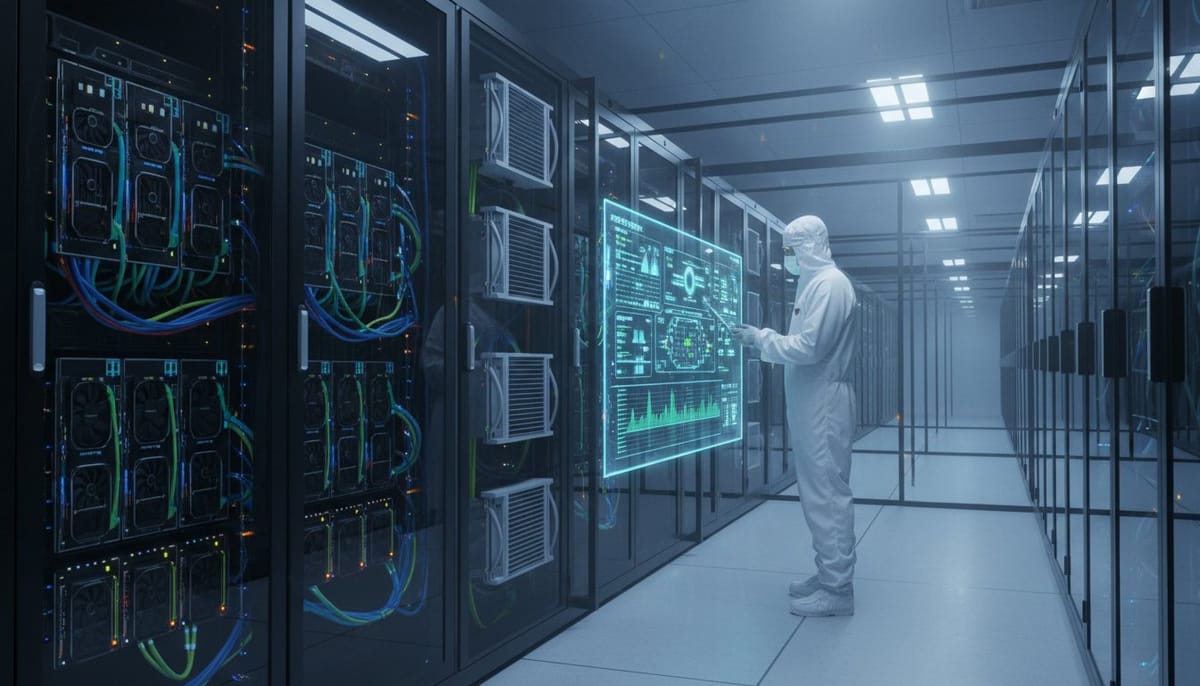
The high power density of GPU servers demands advanced cooling strategies.
- Direct-to-Chip Liquid Cooling: Essential for high-density deployments, bringing coolant directly to hot components for superior heat extraction.
- Rear-Door Heat Exchangers: Capture heat directly from server exhaust, preventing it from mixing with ambient air.
- Immersion Cooling: For extreme densities, submerging servers in dielectric fluid offers unparalleled cooling efficiency.
Enhancing Network Architecture for AI
A robust, high-performance network is non-negotiable for AI workloads, connecting powerful compute resources efficiently.
High-Bandwidth, Low-Latency Networks
- 100/200/400 Gigabit Ethernet: Upgrade your network backbone to support these speeds for massive data flows between compute nodes and storage.
- RDMA (Remote Direct Memory Access): Implement RoCE or InfiniBand to allow direct memory access between servers, reducing CPU overhead and latency.
Spine-Leaf Topologies and Segmentation
- Spine-Leaf Architecture: Adopt this flat, non-blocking design to minimize hops and reduce latency for east-west traffic.
- Dedicated AI Network: Consider segmenting your network to create a dedicated, high-performance fabric for AI workloads, preventing contention.
Designing for Optimal Storage in AI Data Centers
Storage is a frequent bottleneck. An optimized strategy ensures GPUs are continuously fed data.
Flash-Optimized Storage
- NVMe All-Flash Arrays: Deploy NVMe SSDs in all-flash arrays for significantly lower latency and higher IOPS compared to traditional storage.
- Local NVMe Caching: Utilize local NVMe drives within GPU servers as high-speed caches for frequently accessed training data.
Distributed File Systems
- Scalable Parallel File Systems: Implement systems like Lustre, IBM Spectrum Scale, or Ceph, designed to provide high aggregate throughput for large-scale AI training.
- Object Storage Tiering: For less frequently accessed data, integrate cost-effective object storage solutions.
Power and Cooling Considerations for AI Data Centers
The extreme power consumption and heat generation of AI hardware require rethinking traditional data center power and cooling.
High-Density Power Delivery
- Higher Amperage Racks: AI-optimized racks often require 30-50kW or more. Ensure PDUs and electrical infrastructure can support this.
- Busway Systems: Consider overhead busway systems for flexible and scalable power distribution.
Advanced Cooling Technologies
Prioritize liquid cooling solutions for AI densities to maintain optimal operating temperatures and hardware lifespan.
- Chilled Water Systems: Ensure sufficient capacity to support liquid cooling solutions.
- Containment Strategies: While liquid is key, hot/cold aisle containment can still improve air-based cooling efficiency for less dense components.
Management and Orchestration for AI Workloads
Effective management and orchestration are crucial for maximizing resource utilization and operational efficiency.
AI-Specific Orchestration Tools
- Kubernetes with GPU Support: Leverage Kubernetes for container orchestration, utilizing its native support for GPU scheduling.
- Slurm and HPC Schedulers: Effective for traditional HPC or very large-scale, tightly coupled AI training jobs.
Monitoring and Scalability
- Real-time Performance Monitoring: Implement tools for insights into GPU utilization, network bandwidth, and storage I/O, providing the crucial data for effective Data Analytics.
- Scalability Planning: Design with modularity to easily add compute, network, and storage capacity as AI demands evolve.
Conclusion
Optimizing Data Centers for Artificial Intelligence is a multi-faceted endeavor requiring a holistic approach across compute, network, storage, power, and cooling. This comprehensive optimization is a critical component of a successful AI Strategy. By strategically investing in high-performance GPUs, building low-latency networks, deploying flash-optimized parallel storage, and implementing advanced cooling, organizations can create robust infrastructure for demanding AI workloads. Continuous monitoring, intelligent orchestration, and a focus on scalability are vital for sustained AI innovation, including breakthroughs like those detailed in Generative AI: Full Features Guide to Leading Models and Innovations.