AI Assistants vs. AI Agents: What's the Right Choice for Your Business?

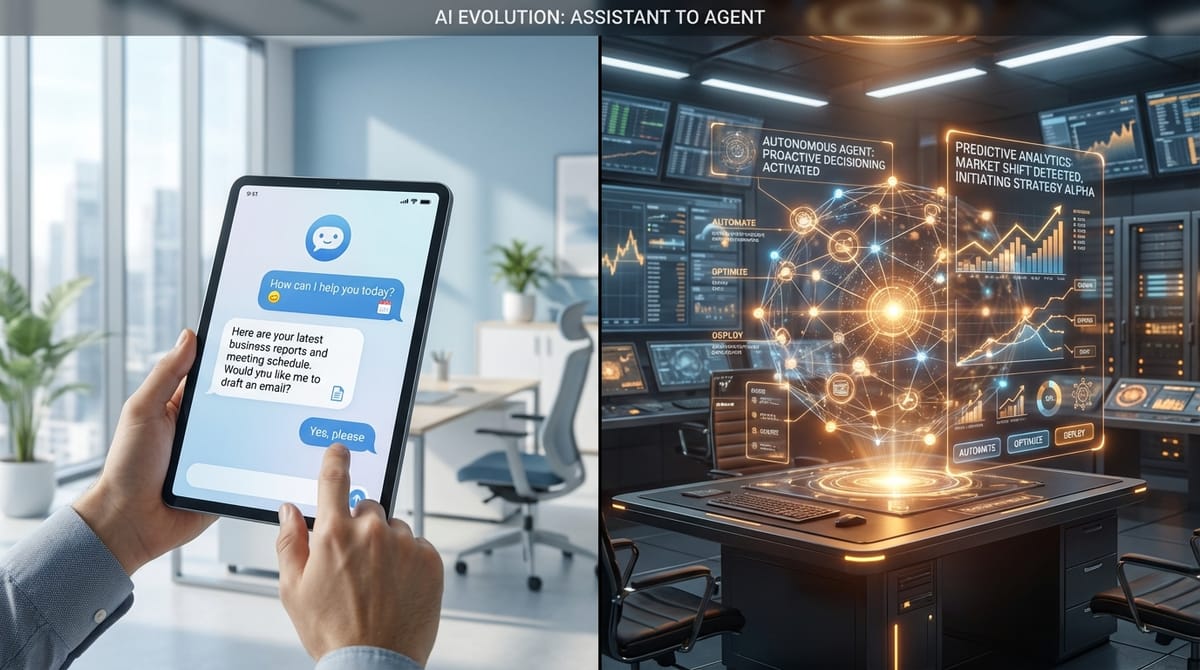
Understanding the AI Landscape: Assistants vs. Agents
In the rapidly evolving world of business technology, artificial intelligence is no longer a futuristic concept—it's a practical tool driving efficiency and innovation. However, as new AI solutions emerge—a trend explored in The Rise of AI Startups: Key Players and Innovations to Watch—so does a new vocabulary. Two terms that are often used interchangeably, yet represent vastly different capabilities, are AI Assistants and AI Agents. Understanding the distinction is crucial for any business leader looking to invest in the right technology to solve the right problems.
While both leverage AI to perform tasks, their core functions, autonomy, and impact on your operations are fundamentally different. Are you looking to answer customer questions instantly, or do you need a system that can proactively manage your entire supply chain? The answer will guide you toward either an assistant or an agent. Let's break down what sets them apart.
What is an AI Assistant? The Power of Reactive Support
An AI Assistant is a software program designed to perform specific tasks based on direct commands or questions from a user. Think of them as your on-demand digital helpers. They are reactive by nature, meaning they wait for your input before taking action. The primary goal of an AI Assistant is to streamline workflows, automate repetitive queries, and provide immediate, accurate information.
You interact with AI Assistants every day. Siri, Google Assistant, and Alexa are classic consumer examples. In a business context, they take many forms, and understanding How to Leverage ChatGPT and OpenAI Models in Your Enterprise Workflow is key:
- Customer Service Chatbots: These are a prime example of AI Assistants at work. They are programmed to understand and answer frequently asked questions (FAQs), guide users through a website, and handle basic support tickets 24/7.
- Virtual Schedulers: Tools that integrate with your calendar to book meetings, send reminders, and find available slots, all based on simple commands via email or a chat interface.
- Internal Knowledge Base Bots: An AI Assistant can be deployed on a company's intranet to help employees quickly find information about HR policies, IT troubleshooting steps, or project documentation.
Key Characteristics of an AI Assistant:
- Task-Oriented: They excel at well-defined, singular tasks like "schedule a meeting" or "what are your business hours?"
- User-Dependent: They require a specific trigger—a voice command, a typed question, or a button click—to operate.
- Follows Predefined Rules: Their responses and actions are based on a pre-programmed set of rules and data sources.
For businesses, the value of an AI Assistant lies in its ability to boost efficiency and consistency. They free up human employees from mundane, high-volume tasks, allowing them to focus on more complex, strategic work that requires critical thinking and emotional intelligence.
What is an AI Agent? The Dawn of Proactive Automation
If an AI Assistant is a helper waiting for instructions, an AI Agent is a manager given a goal. An AI Agent is a more sophisticated, autonomous system that can perceive its environment, make decisions, and take actions to achieve a specific, often complex, objective without direct human intervention for every step.
AI Agents are proactive. You don't give them a series of small commands; you give them a high-level goal, and they figure out the steps to get there. They can learn, adapt, and reason, making them powerful tools for complex problem-solving.
Here’s how AI Agents are transforming business operations:
- Supply Chain Management: An AI agent could be tasked with the goal of "maintaining optimal stock levels." It would autonomously monitor sales data, supplier inventory, and shipping logistics, and then automatically place new orders when needed to prevent stockouts or overstocking.
- Personalized Sales Outreach: An agent could analyze your CRM with the goal of "increasing Q3 sales appointments." It would identify the most promising leads based on past interactions, draft personalized outreach emails, schedule follow-ups, and even update the CRM record—all on its own.
- Financial Market Analysis: A financial agent could monitor market fluctuations, news sentiment, and economic indicators to proactively suggest portfolio adjustments to a human financial advisor, or in some cases, execute trades based on predefined risk parameters.
Key Characteristics of an AI Agent:
- Goal-Oriented: They work towards a broader objective, breaking it down into a sequence of actions.
- Autonomous: They can operate independently and make decisions to navigate unforeseen challenges.
- Adaptive and Learning: They learn from their interactions and outcomes to improve their performance over time.
Which is Right for Your Business?
The choice between an AI Assistant and an AI Agent is a critical part of your AI Strategy and depends entirely on the complexity of the problem you're trying to solve.
Choose an AI Assistant when you need to:
- Automate simple, repetitive tasks.
- Provide instant, 24/7 support for common questions.
- Increase the efficiency of existing workflows.
- Give employees quick access to specific information.
Choose an AI Agent when you need to:
- Automate complex, multi-step processes.
- Handle tasks that require strategic decision-making and adaptation.
- Gain proactive insights to guide business strategy.
- Operate systems with a high degree of autonomy to achieve long-term goals.
Ultimately, the distinction is about reaction versus proaction. An AI Assistant reacts to your needs in the moment, making it an incredible tool for efficiency. An AI Agent acts on your behalf to achieve future goals, making it a powerful partner for strategy and growth. By understanding this core difference, you can make an informed decision and deploy the right AI solution to drive your business forward.