AI Applications and Development: Robotics, Intelligent Agents, and Coding


Navigating the Frontier of AI Applications and Development
The landscape of technology is being rapidly reshaped by Artificial Intelligence (AI), moving beyond theoretical concepts into tangible applications that redefine industries. To understand the broader market dynamics and key players, explore the AI Company Landscape: Understanding Funding, Valuation, and Key Players. For anyone looking to dive deep into AI Applications and Development, understanding its practical implementation in robotics, intelligent agents, and coding is crucial. For a comprehensive overview of the field, refer to our ultimate guide on AI. This guide provides actionable insights and step-by-step approaches to harness AI's power in these transformative domains.
Demystifying Core Concepts: Robotics, Intelligent Agents, and AI in Coding
What are Intelligent Agents?
At its core, an intelligent agent is anything that can perceive its environment through sensors and act upon that environment through actuators. From a software perspective, this could be a program that makes decisions. Practically, intelligent agents range from simple reactive agents (like a thermostat) to complex learning agents (like recommendation systems or autonomous vehicles).
- Reactive Agents: Act purely based on the current percept. Simple, fast, but limited in complex environments.
- Deliberative Agents: Maintain an internal state, reason about their environment, and plan actions. More complex, capable of long-term goals.
Understanding the type of agent you need is the first step in development, dictating the complexity of your AI model and decision-making logic.
AI-Powered Robotics: Beyond Automation
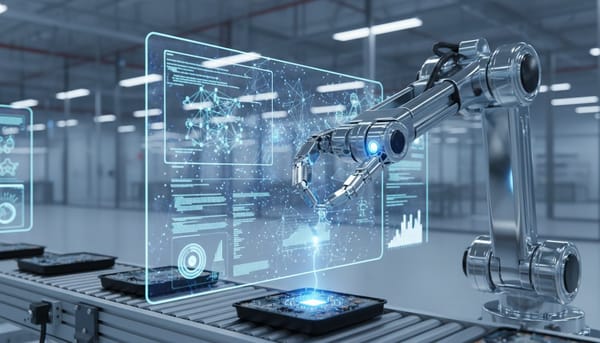
AI robotics integrates AI capabilities into physical robots, enabling them to perceive, reason, and act in complex, unstructured environments. This goes beyond traditional industrial Automation to robots that can learn, adapt, and interact intelligently.
- Perception: Using computer vision (e.g., OpenCV, TensorFlow) for object recognition, navigation, and environmental understanding.
- Manipulation: Employing reinforcement learning or inverse kinematics for precise object handling.
- Navigation: Implementing SLAM (Simultaneous Localization and Mapping) and path planning algorithms.
The fusion of AI with robotics creates machines capable of performing tasks requiring human-like intelligence and adaptability.
AI's Role in Modern Software Development
AI is increasingly becoming a developer's best friend, enhancing every stage of the software development lifecycle. From generating code snippets to identifying bugs, AI tools boost productivity and code quality.
- Code Generation & Completion: Tools that suggest or even write entire functions based on context or natural language prompts.
- Debugging & Testing: AI-powered static analysis, automated test case generation, and predictive bug identification.
- Optimization & Security: AI suggesting performance improvements or flagging potential security vulnerabilities. Ensure the integrity and safety of your AI systems with our dedicated AI Security services.
Embracing AI in your coding workflow means writing smarter, faster, and more secure code.
Practical Guide to AI Robotics Development
Developing an AI-powered robot requires a multidisciplinary approach. Here's a practical roadmap:
Step 1: Defining Your Robotic Application
Start with a clear problem. Do you want a robot that sorts objects, navigates a specific area, or assists in a particular task? Define the robot's goals, the environment it will operate in, and its interaction requirements. For expert guidance in defining your AI initiatives, consider our AI Strategy services.
Step 2: Hardware and Software Stack Selection
- Hardware: For learning and prototyping, consider platforms like Raspberry Pi or NVIDIA Jetson Nano. For more advanced applications, industrial-grade robots or custom hardware might be necessary. Sensors (cameras, LiDAR, ultrasonic) and actuators (motors, grippers) are crucial.
- Software: Robot Operating System (ROS) is the de facto standard for robotic software development. For AI components, Python libraries like OpenCV (computer vision), TensorFlow or PyTorch (machine learning), and Scikit-learn are essential.
Step 3: Building a Simple Object-Tracking Robot (Example)
Let's outline building a robot arm that can detect and pick up specific objects:
- Data Collection & Preprocessing: Gather images of the target objects from various angles and lighting conditions. Annotate these images to label the objects, creating a dataset for your AI model.
- Model Training: Use a pre-trained object detection model (e.g., YOLO, SSD, or Faster R-CNN) and fine-tune it with your custom dataset using TensorFlow or PyTorch. Train it to recognize your specific objects. For advanced model development and deployment, explore our Machine Learning services.
- Robot Control Integration: Integrate the trained AI model with your robot's control system. When the camera detects a target object, the AI provides its coordinates. You'll then use inverse kinematics to calculate the joint angles required for the robot arm to reach and grasp the object.
- Deployment & Iteration: Deploy the AI model onto your robot's processing unit. Continuously test, collect more data on failures, and retrain your model to improve accuracy and robustness.
Developing Intelligent Agents: From Chatbots to Autonomous Systems
Intelligent agents are software entities designed to perform tasks autonomously. Here's how to approach their development:
Step 1: Identifying Agent Goals and Environment
What problem will your agent solve? Is it answering customer queries (chatbot), recommending products (recommendation engine), or managing financial portfolios? Define its scope, the data it will interact with, and its decision-making boundaries.
Step 2: Choosing the Right Agent Architecture
- Rule-Based Agents: Suitable for well-defined problems with clear rules (e.g., simple chatbots following a script).
- Learning Agents: Employ machine learning (supervised, unsupervised, reinforcement learning) to learn from data and adapt (e.g., recommendation systems, game AI).
Step 3: Practical Walkthrough: Building a Goal-Oriented Chatbot
A common and practical intelligent agent is a chatbot. Here's a simplified guide:
- Define Intents and Entities: Identify the user's goals (intents, e.g., 'order_pizza', 'check_status') and relevant information within their queries (entities, e.g., 'pizza_type', 'delivery_address'). For comprehensive conversational AI and language processing, our NLP Solutions can provide robust frameworks.
- Select a Framework: Tools like Rasa, Dialogflow, or Microsoft Bot Framework provide robust platforms for building chatbots. For simpler cases, custom Python scripts with NLTK or SpaCy can work.
- Train the Natural Language Understanding (NLU) Model: Provide example utterances for each intent and entity. The framework's NLU component will learn to map new user inputs to the correct intent and extract entities.
- Implement Dialogue Management: Define how your chatbot responds and progresses the conversation based on detected intents and extracted entities. This is where you define the 'flow' of the conversation.
- Integrate with External APIs (if needed): For tasks like checking order status or placing an order, your chatbot will need to communicate with external databases or services.
- Testing and Refinement: Continuously test your chatbot with diverse user queries. Monitor conversations, identify where it fails, and improve your NLU training data and dialogue logic.
Leveraging AI for Enhanced Coding and Development Workflows
AI tools are revolutionizing how developers write, test, and maintain code. Integrating them into your workflow can significantly boost efficiency.
AI-Powered Code Generation and Completion
Tools like GitHub Copilot, Tabnine, and similar IDE extensions leverage large language models to suggest code completions, generate functions from comments, or even convert natural language descriptions into code. To use them effectively:
- Provide Clear Context: Write descriptive function names, variable names, and comments. The more context the AI has, the better its suggestions will be.
- Review Suggestions Critically: AI-generated code isn't always perfect or secure. Always review, understand, and test any generated code before integrating it.
- Learn from It: Observe how the AI solves problems; it can be a learning tool for new patterns or library usages.
AI in Debugging, Testing, and Optimization
AI can automate tedious and error-prone aspects of development:
- Automated Bug Detection: AI-powered static analysis tools can scan code for common vulnerabilities, logical errors, or anti-patterns, often before compilation.
- Test Case Generation: Some AI tools can analyze code logic and automatically generate unit or integration tests, increasing test coverage.
- Performance Profiling: AI can analyze runtime behavior and suggest code optimizations to improve efficiency.
Practical Application: Integrating AI for Code Quality
Consider integrating AI-powered linters or security scanners into your Continuous Integration/Continuous Deployment (CI/CD) pipeline. Tools like SonarQube (with AI features) or custom scripts leveraging AI models can automatically flag issues during code commits, ensuring higher code quality and security standards are maintained throughout the development cycle.
Conclusion: The Future is Integrated
The journey into AI Applications and Development, particularly in robotics, intelligent agents, and coding, is dynamic and rewarding. By understanding the core concepts, adopting practical development methodologies, and leveraging AI-powered tools, you can build sophisticated systems that solve real-world problems. The key is continuous learning, experimentation, and a willingness to integrate AI as a powerful partner in your development efforts. Embrace this frontier, and you'll be at the forefront of innovation.